Ryanair's O'Leary seeing 'most optimistic time' in 25 years
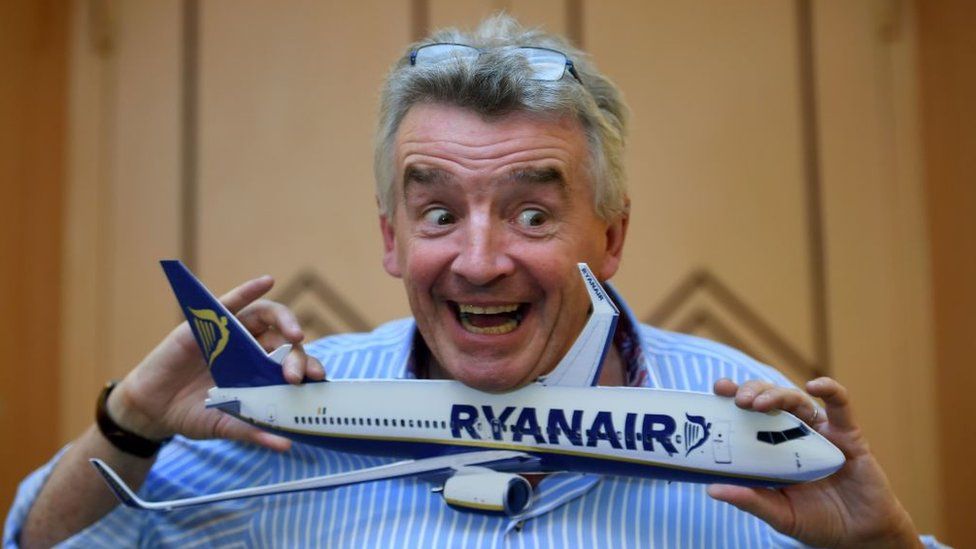
Ryanair Group chief executive Michael O'Leary has hailed the current operating environment as creating the most exciting period for the airline since deregulation of the sector in the mid-1990s.
During a webinar organised by air traffic manager Eurocontrol on 29 November, O'Leary said it was the "most optimistic time in air travel in past 25 years" as passengers rushed back to the skies following the pandemic's retreat.
“Everyone is getting back flying, tourism is getting back, hotels are filling up, everyone getting moving again, and I have never seen such a sense of optimism," he adds.
Ryanair Group is projecting that it will fly 225 million passengers by 2026, compared with around 168 million this year – a slight increase compared with 2019.
The airline is one of few in Europe to have used the pandemic to bolster its market share and increase capacity, aided by a 210-strong order for Boeing 737 Max aircraft.
It has been stepping into markets vacated by legacy airlines that retrenched amid the pandemic and are yet to rebound in the face of higher costs, debt burdens and a lack of capacity.
Ryanair mainline chief executive Eddie Wilson, speaking during the same webinar, pointed out that the company had placed an extra 25 aircraft in Italy post-pandemic, for example.
He believes that Portugal, Scandinavia and Germany offer further opportunities as market space opens up. In Germany, for example, short-haul capacity fell by a quarter during the pandemic.
Opportunities are opening up at airports previously reliant upon national carriers to sustain their business models.
"You had a long line of airports that realised that once the carousel stopped during Covid: who is going to fill my airport?" he observes. Many are offering space to Ryanair and lowering their prices.
Although the economic conditions are challenging, employment remains strong across Europe and people built up savings up during the pandemic, he points out. "Recession is different this time round."
Wilson argues that in difficult economic times consumers migrate to the lowest-cost operator – which, in Europe, means Ryanair. "In our situation, you've got the most modern aircraft, it goes on time, cheapest prices... Once you make that change you are never going back to paying three-to-four times the prices that you did previously."
O'Leary further predicts that the more challenging environment could trigger rapid consolidation in the European airline market over the next several years as the continent's remaining independent airlines are snapped up by larger groups.
"If you can't grow in this industry, you're going backwards because your costs keep growing but your revenues don’t," he says. "This is my personal view, but EasyJet in the next two-three years, they’ll be bought by either BA or Air France, or a combination of the two," he predicts, citing the dominant carriers within groups IAG and Air France-KLM, respectively.
EasyJet has in the past faced questions about its positioning in the middle of the market and its ability to remain independent. Last year, it rebuffed an approach by low-cost rival Wizz Air that would have formed a low-cost giant broadly of the same size as Ryanair.
Turning to Wizz itself, O'Leary suggests that it will "probably" by bought by Lufthansa.
In southern Europe, he expects TAP Air Portugal to be purchased by IAG, while ITA could go to either Lufthansa or Air France-KLM, he speculates.
In both cases, he highlights the significant assistance they have required from their respective home governments, putting the airlines in a position that he argues is unsustainable in the long term.
Meanwhile, Scandinavian operators SAS and Norwegian are companies that "no one really wants", in O'Leary's view. If combined into a wider group they would, in his characterisation, "keep each other propped up like two drunks walking back from the pub".
Consolidation in Europe has been predicted for many years, not least by O'Leary himself, as smaller players are squeezed by greater competition.
But O'Leary now believes that it could rapidly play out over the next two-to-three years with Covid-era support having been withdrawn.
He believes the largest airlines in Europe are now far more effective organisations than in the past – and therefore stronger competitors.
"Air France, IAG, Lufthansa are well-run groups," he says. "They have good management teams. I have nothing but respect for them."
One result of consolidation would be "slightly higher airfares", he adds.